
Pillar 1: Documentation
Minimum Viable Systems (MVS)
Listen to this chapter · 28 min, narrated by David Jenyns
Think about the miracle that is the human body for a moment. Right now, as you’re reading these words, an incredibly sophisticated set of systems is working in perfect harmony to keep you alive. Your heart beats about 100,000 times every day, pumping blood through roughly 97,000 kilometres of blood vessels. Your lungs will breathe in and out around 22,000 times today, delivering vital oxygen to every cell in your body. Your digestive system will break down food into the exact nutrients needed to keep everything running.
But what’s truly extraordinary isn’t just these individual systems – it’s how they work together. Each system depends on the others to function properly. Your respiratory system needs your circulatory system to distribute the oxygen it takes in. Your digestive system relies on your endocrine system to regulate metabolism. Your muscular system requires your skeletal system for support and movement.
It’s obvious when I say it but, if any one of these vital systems fails, the consequences can be severe. A problem with your immune system leaves your whole body vulnerable to attack. Issues with your circulatory system can affect everything from your energy levels to your brain function. In the worst cases, the failure of a critical system can be fatal. Even less severe issues can have far-reaching effects. A minor problem with your digestive system might affect your energy levels, which impacts your ability to exercise, which then affects your cardiovascular health, and so on. It’s all connected.
Your business: a living system
This is exactly why I love using the human body as an analogy for business. Because your business operates in exactly the same way. Just like your body, your business is a collection of vital systems (marketing, sales, operations, finance, HR, management, etc.). They’re all interconnected. Remove one, or even just allow it to become inefficient, and the whole business will eventually suffer.
For example, a weak finance department can lead to cash flow issues, which impedes growth, even if every other part of the business is excelling. Conversely, when every department is functioning optimally, the business remains healthy and is capable of thriving, even when external forces put pressure upon it.
The good news is, your business isn’t as complex as the human body. Which is just as well since trying to systemise your business to the same level of minutiae as the human body would be an almost impossible task. I’ve seen what happens when a business tries to systemise everything and it’s always a disaster. Aside from it being a herculean task that eventually collapses under the weight of its own ambition, it’s impossible to keep up with the ongoing work of updating and improving the systems you do manage to put in place.
So where do you start? Which systems should you document first? This is one of those times it pays to be selective. Heard of the 80/20 rule? It suggests that 20 percent of your efforts produce 80 percent of your results. Well, when it comes to business systems, this principle couldn’t be more applicable.
It means you can achieve extraordinary results by focusing your attention on just that critical 20 percent. We call this your Minimum Viable Systems (MVS): the 20 percent of systems that deliver 80 percent of your results. Think of it as identifying the critical tasks your vital organs must accomplish to remain healthy.
There’s also another important point to understand here. Just because something isn’t documented doesn’t mean it magically stops happening. Your business is already functioning without documentation and will continue to do so. Finding your MVS is about being strategic, identifying what’s truly critical rather than trying to capture everything.
Is it essential, repeatable and delegable?
There’s a knack to identifying the systems that will most benefit the business by being documented. This will come with time and practice. But the above question – “is it essential, repeatable and delegable?” – is a good mantra to keep front of mind.
The first two concepts, “essential” and “repeatable”, are pretty self-explanatory. If a system is crucial to the core function of the business and is performed regularly with minimal variation, it’s a prime candidate for the standardisation benefits that come from systemising it.
Delegation, however, is a little more complex and is worthy of explanation because using this to help you select which systems to document is going to offer some unique advantages.
One of the long-term goals of SYSTEMology is to systemise processes to the extent that it becomes possible for lower-skilled team members (or machines) to complete them. The result is that more skilled individuals can eventually let go of those tasks altogether and work on more strategic elements of the business, such as problem-solving and driving business growth.
Systemisation can, in effect, move processes down through the chain of experience and ability so they’re managed on a lower level. This is great for less experienced workers who can become involved with more interesting and valuable areas of the business. And it’s even better for more senior workers who are liberated from repetitive tasks that keep them from spending time on higher value tasks.
Wherever possible, find tasks that fit into all three categories: essential, repeatable and delegable. Prioritise those tasks that are already being successfully completed in the business and avoid activities that are not yet being done.
This exercise is aimed at finding already successful habits and making those repeatable. I think it’s easiest if we jump straight in and make this practical. Head to SystemsChampion.com/resources to download the MVS template.
How to find your Minimum Viable Systems
Step 1: Identify your business departments
Every business has distinct functional areas. These are like the vital organs in your body. Each plays a crucial role in keeping your business alive and healthy. Start by considering these six core departments that exist in virtually every business.
- Marketing: This is your business’s voice to the world, responsible for getting your message out to potential clients and generating leads. Your marketing department handles everything from creating content and advertising campaigns to broadcasting emails to your database, all designed to attract your ideal clients.
- Sales: Once marketing has attracted potential clients, your sales department takes over. They’re responsible for converting interested prospects into paying clients. This includes managing your entire sales process, from creating proposals and following up with leads to bringing new clients smoothly into your business.
- Operations: Think of operations as the engine room of your business. This is where your products or services get delivered. Your operations team ensures quality control, manages client relationships and oversees all the processes that deliver value to your clients.
- Finance: This department manages the flow of money through your business. They handle everything from sending invoices and collecting payments to managing expenses and monitoring cash flow.
- Human Resources: This department ensures you have the right team in place. They oversee recruitment, onboarding and parts of performance management, while also nurturing your team culture and maintaining clear internal communications.
- Management: Like your brain coordinating your body’s activities, your management department provides direction and oversight for the entire business. They handle strategic planning, business development and performance monitoring, ensuring all departments work together effectively toward common goals.
Step 2: Identify your core systems in each department
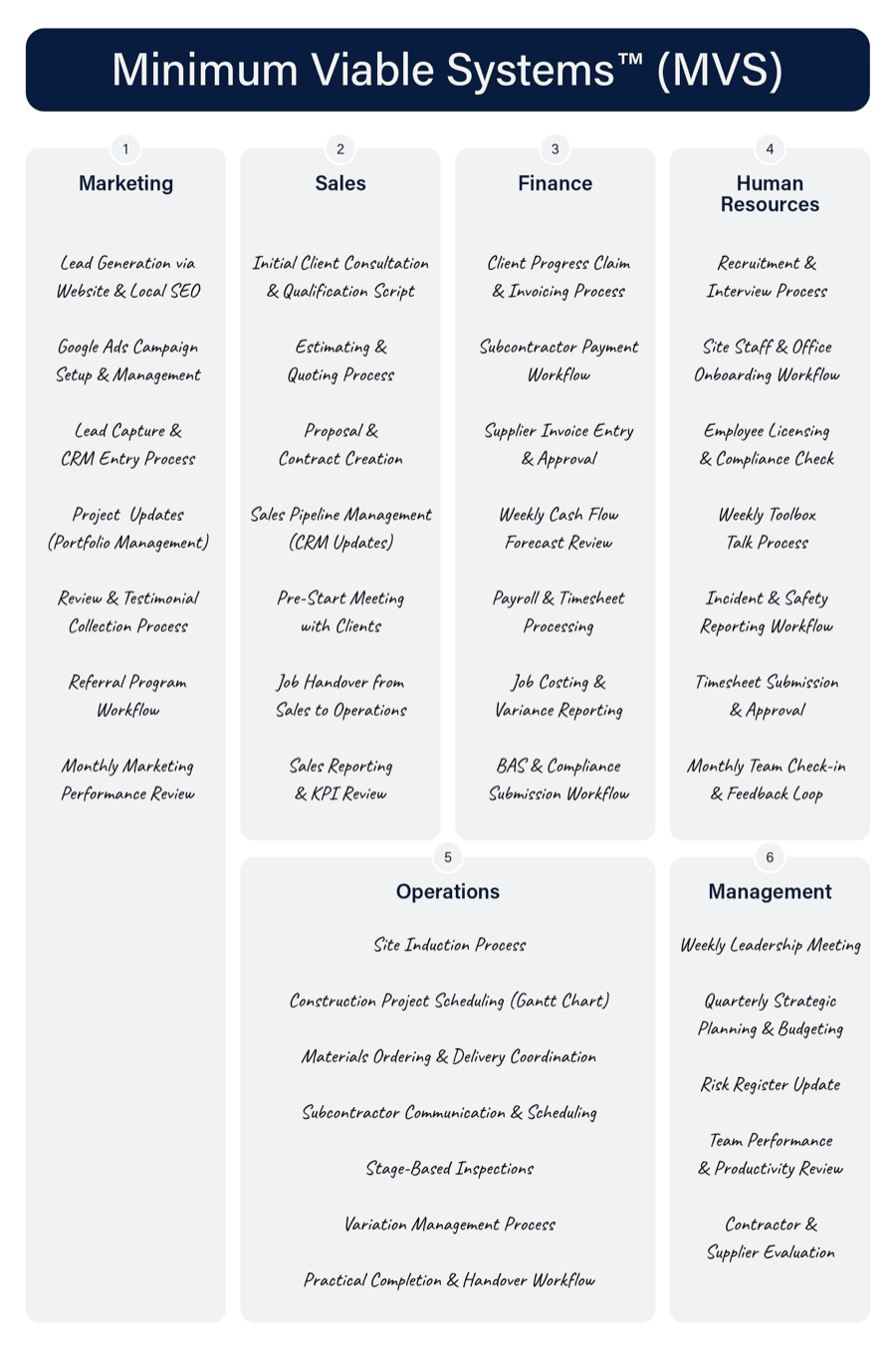
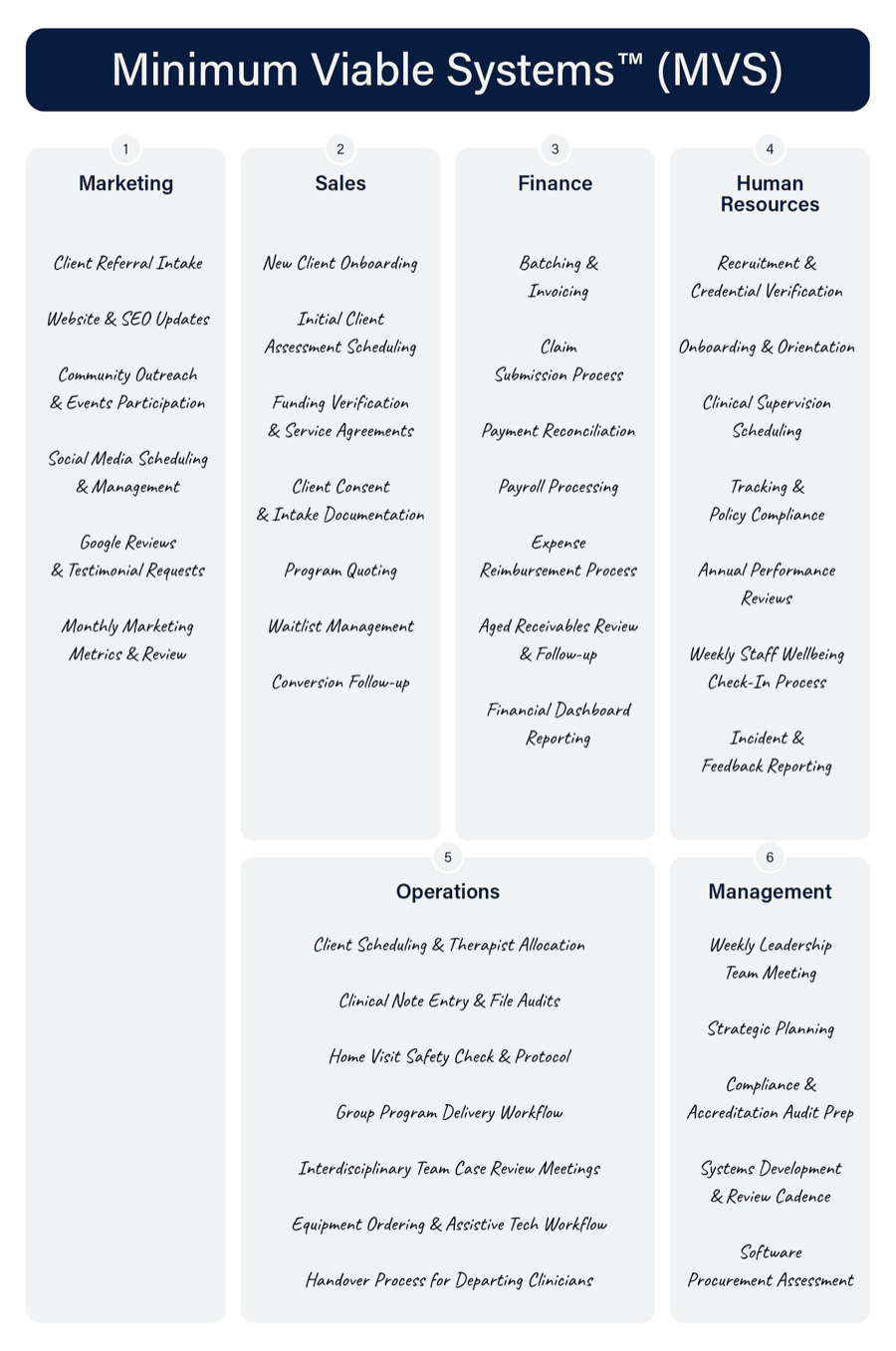
In this step you’re going to systematically work your way through each of the identified departments with a specific line of thinking: “If I had to pick the most critical seven tasks going on in this department, that are essential to this department being a success, what would they be?”
It is recommended you do this in conjunction with either the business owner and/or department head if/where this person has been nominated. These team members will help you prioritise based on their knowledge of their respective departments.
If you get stuck it might be helpful to consider under what cadence these tasks occur. Ask what tasks may happen on a triggered basis (e.g. taking a phone call) as opposed to others that may occur at specific intervals like daily, weekly, monthly, quarterly or annually (e.g. creating a monthly report).
Here’s what a completed MVS looks like across all six departments. (You can download both these examples and an empty template at SystemsChampion.com/resources.)
Step 3: Share your completed MVS
Once you’ve worked your way through all the departments, it’s time to share what you’re doing with the wider team. Here’s something I’ve learned over years of helping businesses systemise: the most successful Systems Champions don’t work in isolation. They understand that getting buy-in from the entire team isn’t just helpful but essential.
When you share your MVS, several powerful things happen. First, you get invaluable feedback. The business’s team members are in the trenches every day, working with these systems. They might spot critical processes you’ve missed or help you prioritise what truly matters.
Second, you create alignment. When everyone can see how their department’s systems connect with others, they understand their role in the bigger picture. It’s like showing each organ in the body how it helps keep the whole organism healthy. This understanding naturally leads to better cooperation between departments.
Third, you build momentum. When team members see their critical processes being documented and valued, they become more engaged in the systemisation journey.
Step 4: Create your MVS scoreboard
Now that you’ve identified a maximum of 42 critical systems to be documented, shortly you’re going to start the process of documentation and organisation. But first, let’s create a dashboard to measure your progress. Think of this as your systemisation scoreboard, which everyone can follow – a simple way to track what’s done and what’s next.
Let’s keep it refreshingly simple with a basic spreadsheet. Your scoreboard will track five elements: the department name, system name, current status, knowledgeable person who knows how the task is completed and the target completion date. I made a template for you at SystemsChampion.com/resources.
If you want to go one step further, you can colour-code the status of each system. White cells show systems not yet started, orange indicates those in progress and green celebrates the ones fully documented. This visual approach gives everyone on your team an instant snapshot of your progress. There’s something deeply satisfying about watching those white cells turn orange, and even more satisfying when they finally turn green. I’ve seen entire teams get excited about their “green count” growing week by week.