
Pillar 1: Documentation
Documented Habits
Listen to this chapter · 17 min, narrated by David Jenyns
“Without standards, there can be no improvement.” — Taiichi Ohno, father of the Toyota Production System
Think about the last time you had a Big Mac. Whether you ordered it in New York, Tokyo or Melbourne, Australia, it probably tasted exactly the same. That’s no accident. But this story of systematic perfection didn’t start in a boardroom. It started with a curious milkshake mixer salesman named Ray Kroc.
In 1954, Kroc was 52 years old and making a modest living selling milkshake mixers when he noticed something odd. A small restaurant in San Bernardino, California had ordered an unusually large number of his machines. Intrigued, he decided to visit the place personally.
What he discovered that day would change business history forever. The McDonald brothers, Dick and Mac, had created something revolutionary: what they called the “Speedee Service System”. While other drive-ins of the 1950s were chaotic affairs with carhops, lengthy menus and 30-minute wait times, the McDonald brothers had engineered an operation that worked like clockwork.
Their kitchen was a marvel of efficiency, laid out like an assembly line. Every movement was choreographed, every process standardised. They had stripped their menu down to just a few items, designed custom equipment for consistent cooking and created precise protocols for food preparation. They specified exactly one squirt of ketchup and one of mustard on every burger. The result? They could deliver a consistently perfect meal in under a minute.
But what really caught Kroc’s attention was that he could see how the system could be replicated anywhere. While the McDonald brothers were content with their local success, Kroc envisioned bottling their efficiency and reproducing it across the country. It wasn’t just about selling hamburgers. It was about selling a proven system of selling hamburgers.
This is systemisation at its finest. They took all the knowledge that traditionally lived in a chef’s head (the timing, the temperature, the techniques) and transformed it into step-by-step instructions that anyone could follow. No more “you just know when it feels right” or “it comes with experience”. They made the invisible visible.
The challenge most small businesses face is quite scary. Their most valuable asset, their intellectual property, isn’t truly theirs – it’s trapped in the minds of their employees. Think about it. Every business spends years developing their “special sauce” through countless hours of trial and error. Star performers have honed remarkable skills and insights, developing techniques that reliably produce exceptional outcomes for clients. Yet without proper documentation, this hard-earned expertise (the very DNA of your business’s success) remains trapped inside their heads. If they go, so too does that expertise.
So much of your team’s daily work, far more than most realise, represents years of accumulated wisdom and experience. These are the habits and practices that have been refined through thousands of hours of real-world testing. Some are brilliantly efficient, some need improvement, but they all share one critical trait: they exist only in the minds of your team members. This means your business’s most valuable asset, its operational intelligence, walks out the door every evening.
Documentation solves this. It’s the foundation of systemisation, the first pillar that makes everything else possible. Think of it as capturing your company’s operational DNA. It transforms all those invisible positive habits into a visible, living playbook that can be shared, refined and scaled.
When you document these habits, something magical happens. You turn implicit knowledge into explicit instructions – a “how-to” that anyone can follow to complete the same work. Will they immediately match the expertise of your seasoned pros? Probably not. But they’ll be able to achieve a successful outcome by following the documented process.
Now, am I suggesting you systemise like McDonald’s? Not exactly. You need to be careful blindly copying other businesses’ strategies because I’m going to guess you’re probably not running a hamburger shop. You’re probably not employing 15-year-olds who’ve never had a job before, and you may (or may not) be looking to become a global enterprise.
You’re just starting on your systemisation journey and your business probably deals with different levels of complexities and team member skill levels. This doesn’t mean documentation isn’t important. It just means you need a different approach. You need documentation that matches your business’s sophistication while still providing the clarity and consistency your clients crave.
Training new skills and habits
The Conscious Competence Ladder (developed by Noel Burch) describes the stages individuals progress through as they acquire new skills and habits. And it quickly becomes evident when looking at it through the lens of systemisation how documented processes can accelerate the way in which people master new skills.
- Unconscious Incompetence – “You don’t know what you don’t know”: This is where everyone starts. New team members don’t know what they don’t know and that’s to be expected. You might even have existing team members who are blissfully unaware that there are better ways of completing their tasks. Sadly, this blindness creates waste and leads to more mistakes than you realise.
- Conscious Incompetence – “You know what you don’t know”: Documented processes that capture best practice reveal to the team members a better way of doing things. Team members become aware that they are not doing things in the most efficient manner. For some, this can create feelings of overwhelm and frustration, while for others, it motivates them to improve. Either way, the first step toward improvement is awareness.
- Conscious Competence – “You know and do but you have to think about it”: Systemisation done well helps team members dramatically improve their output by consciously following established processes. They gain new skills but it takes effort to keep using them and not slip back into old habits. The individual may need to keep referring back to the system, and use guides, checklists and tools to ensure they’re following the process.
- Unconscious Competence – “You know and do without thinking”: In the final stage, working the systems becomes second nature and the person uses their new abilities effortlessly and without conscious thought. Everything is intuitive and automatic. Team members at this level are the most helpful for improving existing systems and developing new ones.
Understanding where each team member is on this ladder helps you provide the right support in their systemisation journey. Some people you work with will be at the bottom of the ladder and need a gentle introduction to new ways of doing things. Those in stage two will need reassurance and support. At stages three and four, you have team members who are going to be powerful allies in shaping the company’s systemisation culture.
Meet people where they are
Start by acknowledging that documentation isn’t about criticism but about improvement. Every process you document is an opportunity to make your business better. When team members understand this, they’re more likely to embrace the documentation process rather than resist it.
And remember, the goal isn’t perfection. It’s progress. That’s where the real magic of systems lives.
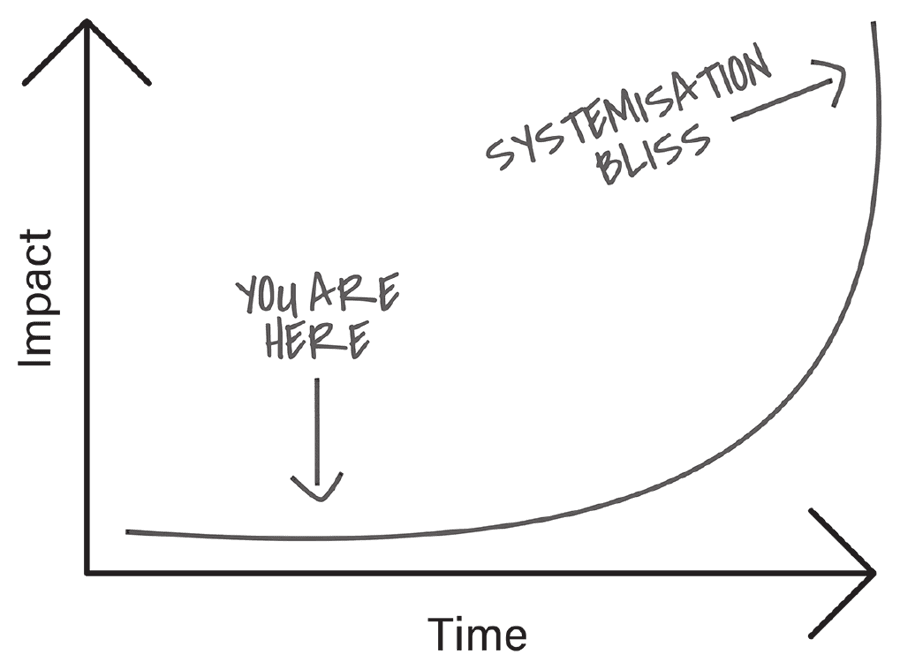
Each system you create adds a small percentage of improvement to your business. A documented client onboarding process might save 10 minutes. A standardised email response system could save five. A simple invoicing process might save 10 minutes. Individually, these improvements might seem modest, but these gains stack and accelerate. Ten systems, each saving just five minutes per use and reducing error rates, could give you back 10 or more working days annually.
But the true transformation happens when your systems work together and amplify. Just like good habits compound into great results, systems multiply each other’s effectiveness. This isn’t simple addition – it’s multiplication! That client onboarding system is now fuelling your welcome process, tightening your feedback loops and sharpening your service all at once. Each system reinforces and enhances the others, creating a web of efficiency that becomes a force multiplier for exponential growth.
So where do you start with documentation?