
For the Business Owner
This Is Your Stop
Listen to this chapter · 24 min, narrated by David Jenyns
A system for systemising your business sounds a bit like a snake eating its own tail. But really, how could it be any other way?
If you’re sold on the idea that systemising your business is critical to maximising performance, you intuitively know you must follow a system to systemise your business.
Of course, when I say you follow, what I really mean is that your Systems Champion is following the system. Because this is the part where you step aside and allow them to take the reins. As tempting as it may be to micromanage their work or continually look over their shoulder, it’s important that you give your Systems Champion the time, resources and authority they need to learn the role, make some mistakes, figure out how to overcome obstacles and eventually make a success of the project. They will be doing the bulk of the work, so you need to give them room to do it.
Which isn’t to say your responsibility ends here.
I encourage you to read the remainder of this book before you hire your Systems Champion. Firstly, so that you have a crystal-clear idea of what skills are needed in the role, and secondly, so you know what to expect from their output and have a way of measuring their progress.
Yes, you’ll need to give them some time to establish their own system of working, but it’s still your duty to keep an eye on what your Systems Champion is accomplishing and to measure the effects.
In practice, as you’ll see over the coming chapters, you will still be involved in the project from a top-level perspective. This will mainly take the form of strategy and priority discussions with your Systems Champion, accompanied by regular updates on their progress. But arguably even more important is the way in which you support your champion in their work and demonstrate to all of your team your commitment to systemisation.
A few years ago, I had the privilege of working with Michael E. Gerber (perhaps best known for his book The E-Myth, a work which explores the myths and challenges common to small business development) and I sent him an early copy of my previous book, SYSTEMology. He gave me some valuable feedback. The most important, in my opinion, was this comment:
You can’t let the business owner off the hook.
You see, I had it in my head that I wanted to get the business owner out of the way as quickly as possible so the Systems Champion could get on with making the systemising happen. And while there’s some merit to that – the SYSTEMology process goes faster the more the business owner is able to step back and let their champion take charge of the role – Gerber was saying I shouldn’t position this as the business owner effectively washing their hands of the project.
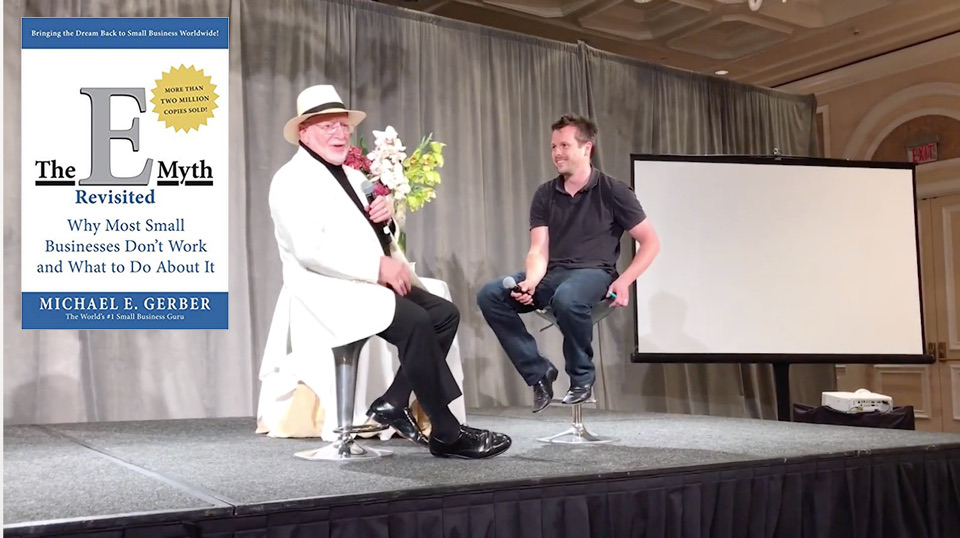
You’re not going to be involved in the actual hands-on process of documenting, organising and optimising the systems in your business, but you’ll still play an important role in helping your Systems Champion be successful. And one of the key elements is being visibly and audibly behind the work your champion is doing.
I’ve already hinted at this but, for reasons I’ll come to later, not everyone in your business is going to be enthusiastic about the systemisation process, and some may outright oppose it. You need to make it clear, from day one, that you are 100 percent behind this project, that it’s important to the long-term health of the business and that you expect everyone to give your champion their support.
There’s a balance to be struck here. On the one hand, you want your Systems Champion to have the autonomy to manage the project in their own way, and you want to avoid becoming too involved to the point where it becomes a time sink. On the other hand, you can’t abdicate responsibility entirely.
It’s also important to note that, as the SYSTEMology project progresses, there may be opportunities for you to become more involved. For example, as systems are documented, you may spot some areas in which optimisation is insufficient, and where a process may need completely re-engineering from scratch. Depending on the value to your business, developing an entirely new process may in fact be a very good use of your time.
But for now, this is your stop.
The next chapter, and all the ones that follow, are a guide for your Systems Champion. This is a step-by-step guide to the practical, hands-on work of making SYSTEMology a reality and it’s the champion that is going to be carrying out this crucial work.
The results are going to be extraordinary.
SYSTEMology works 100 percent of the time when it’s properly applied by a person who is clear on their vision of improving their business. After only a few months, you’ll notice that the positive effects of systemisation begin to compound. Each system that is documented and optimised adds a percentage of improvement, and the resulting benefits stack and accelerate.
Let me leave you with a simple example to show you exactly what I mean. Imagine you run a small service business, which looks like this:
- You have 5000 potential customers per year.
- You convert 25% of those leads (one in four leads becomes a customer).
- Giving you 1250 customers (5000 × 25%).
- Each customer purchases from you two times per year.
- Your average sale is $400 per transaction.
- Giving you an annual revenue of $1,000,000 (1250 × 2 × $400).
- Your profit margin is 25%.
- Giving you an annual profit of $250,000.
Now, here’s where the magic of systems becomes clear. Through systemisation (turning your best lead generation practices into repeatable processes, capturing your top salesperson’s approach for everyone to follow, creating consistent customer follow-up systems, standardising service delivery, and reducing errors through documented procedures) you get a 10 percent improvement in each area.
This is what it looks like after systemisation:
- You now attract 5500 potential customers per year.
- You convert 27.5% of those leads into customers.
- Giving you 1513 customers (5500 × 27.5%).
- Each customer now purchases from you 2.2 times per year.
- Your average sale has increased to $440 per transaction.
- Giving you an annual revenue of $1,463,212 (1513 × 2.2 × $440).
- Your profit margin has improved to 27.5%.
- Giving you an annual profit of $402,383.
The results are extraordinary:
- Revenue increased by 46% (from $1,000,000 to $1,463,212).
- Profit increased by 61% (from $250,000 to $402,383).
- That’s an additional $152,383 in annual profit!
This demonstrates the compounding power of systems. You didn’t need to double anything or make dramatic changes. Just very achievable 10 percent improvements across a handful of key areas created a 61 percent increase in profit.
This is why I’m so passionate about this stuff! These numbers aren’t theoretical. Through proper systemisation, 10 percent gains in each area are not only achievable, they’re conservative. And when you consider adding AI into the mix, you’ll make even bigger gains. Expect to see small improvements in the short term, but look out for the eventual point of critical mass when it will feel like the entire business has suddenly jumped into a whole new level.
And relax, I know what you’re thinking: Great, just what I need … more tasks on my to-do list! The good news? Your soon-to-be Systems Champion can help with many of these items. Your main job right now is finding the right person to drive this forward. After all, isn’t delegating tasks like these exactly why you’re reading this book?